
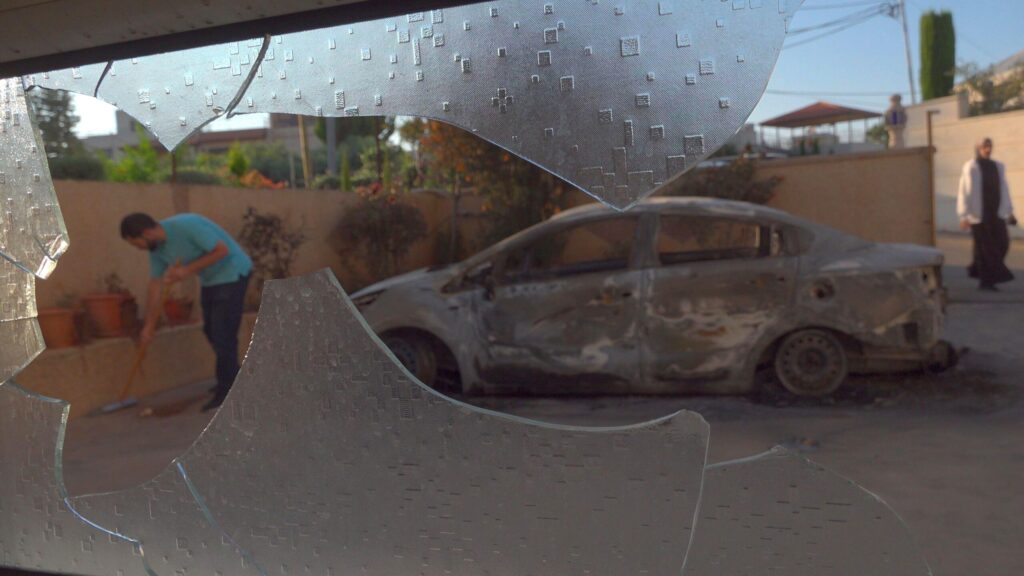
In June 2023, around 400 armed settlers stormed my town, Turmus Ayya, while Israeli soldiers stood by for at least fifteen minutes before entering. The settlers torched more than thirty homes and sixty cars. As Israeli forces eventually moved in, they opened fire and killed Omar Qattin, a 27 year old father of two, unarmed near his home. The next day, a smaller group came back, this time to the other side of town, while soldiers again stood and watched. They threw stones at my own home while my mother, my sisters and I were inside. Almost everything that happened in those two days was caught on video, by residents, by neighbours, by security cameras, but no one was ever charged or damages paid. When we called to report the incidents to the US embassy (many residents of Turmus Ayya are Palestinian bi-nationals with US citizenship), we were told to call the same Israeli army that was attacking us.
The footage was used in media reports and circulated widely on social media, but it has not yet brought any form of accountability. However, it continues to serve as an archive, preserving evidence of what happened to us so that it cannot later be dismissed as a rumour, an exaggeration, a matter of interpretation or a dispute. For Palestinians, documentation itself, whether through filming, translating or putting your name to a testimony, is its own form of self-determination, its own form of resistance, even if it cannot yet be used as a vehicle to access justice.
Risks high, accountability elusive
A UN inquiry published in June 2026 found that Israeli settler attacks on Palestinian villages and farmland led to a 133% increase in Palestinian deaths and a 130% increase in injuries in 2025 compared to the previous year, and that Israeli forces are frequently present alongside settlers during these assaults, providing cover and not stopping them. Ordinary civilians who film or otherwise document the violence have no protection: no press vest, no institution behind them and usually no lawyer to call.
The decision to monitor, document or bear witness is not simple at all. It is a choice made under significant risk, repeated again and again, weighed each time against what it could cost you, your family and your wider community. Filming a soldier or a settler can put a target on your back or your family’s, whether the footage circulates publicly or not. It can result in your phone being confiscated or smashed on the spot, your arrest and interrogation, hours held at a checkpoint or entry denied at the border.
Even reaching for a phone can be its own risk calculation. I have stood at checkpoints with my phone half out of my pocket to film and pushed it back down because a soldier stood there with his weapon, and any motion can be read however he chooses. The decision gets made in a second: raise the phone and risk provoking a reaction or lower it and let whatever is happening go unrecorded.
Yet even after taking that risk, rarely does it lead to any form of justice or accountability. Security cameras across my own village captured the mob’s path that day, footage detailed enough to follow people street by street, and still no Israeli settlers were arrested over the attack on Turmus Ayya and no compensation was paid. Two days after the attack, seventeen diplomatic missions visited Turmus Ayya, met with affected families and condemned the violence, calling on Israel to bring those responsible to justice. However, their calls fell on deaf ears. Although the Israeli military acknowledged that it ‘failed to prevent’ the attack, it has neither issued an apology nor afforded victims any other adequate remedy. Israeli prosecutors did eventually bring terrorism charges against one settler, but only over a mosque vandalized in a different village hit during the same wave of attacks. That prosecution itself was the exception: according to Yesh Din, an Israeli group tracking settler violence in the Occupied Palestinian Territory since 2005, roughly 94% of cases investigated between 2005 and 2024 in the West Bank closed without an indictment and barely 3% led to a conviction.
Nor have civil proceedings provided a meaningful avenue for accountability or redress. Ceasefire’s database tracking nearly 500 Israeli court cases found that roughly nine in ten civilian harm claims brought by Palestinians against the state are rejected. Over the past decade, Israeli courts awarded Palestinian claimants a combined ILS 24.4 million across 78 successful cases, compared to ILS 438.7 million awarded to Israeli citizens in just 24 claims against the Palestinian Authority over the same period. As Temple University’s Professor Gilat Bachar, one of the database’s lead researchers observed: ‘While Jewish Israeli citizens who are residents of the OPT have a right to claim compensation for losses they sustain from the operations of Israel’s security forces, non-Jewish residents effectively have no corresponding right.’
When political and judicial accountability remain out of reach, documenting daily harm is exhausting and can feel futile. You take the risk. You bear the consequences. And still, nothing happens. Faced with that reality, some people decide the cost is simply too high. They stop recording or never start at all.
Normalized violence is harder to recognize
Grave human rights abuses and international humanitarian and criminal law violations committed against the Palestinian people are, by most measures, among the most documented in the world. From mass casualty events geolocated by Forensic Architecture to long-term monitoring undertaken by B’Tselem, this record exists because Palestinians and their allies fought to build it. Yet, a focus on the most serious incidents leaves a gap. The routine violence of occupation often goes unreported and unrecorded: a checkpoint closure that costs a student her exam or a family their hospital appointment, a worker docked pay for a delay he did not cause. Not only because of the risks and challenges associated with documentation, but also because violence that is routine becomes harder to recognize and respond to, even when the effects compound over time.
This extends to physical attacks by settlers, evidence of which is not always fully captured or systematically documented. Residents in Turmus Ayya say attacks by settlers have become nearly constant in recent months, intensifying since settlers built an outpost on village land. The pattern holds across the West Bank, where the UN recorded the highest monthly rate of settler attacks since it began tracking the figure in 2006, averaging roughly eight attacks daily resulting in casualties or property damage in October 2025.
For many years, I did not keep a record or speak out about incidents of perceived lower gravity that formed part of everyday life under occupation. For instance, being stopped and having my ID checked twice on the same short trip, or the sound of gunfire and smell of tear gas at night, common enough I stopped registering it, or a neighbour’s home being raided and searched, or the water and power cuts we learned to work around.
Choosing to preserve our own lived experience
Last summer, my daily commute to Ramallah, normally twenty or thirty minutes, stretched to two hours each way because of checkpoint closures and forced detours. Soldiers moved into my town on and off almost every day that summer, and I filmed some of it: checkpoint stops, road closures, soldiers in our streets, tear gas. I wanted to record and show what an ordinary day looked like from my own perspective.
Amid the rapid spread of mis/disinformation and mainstream media narratives that lack nuance and are not informed by the lived experience of ordinary Palestinians, there is a strong desire among local people and organisations to tell their own stories. Gaza XR is a virtual reality project documenting life in Gaza, aimed at showcasing its culture, history and resilience, and the multi-dimensional realities of life under siege.
One testimony I translated for Gaza XR was from Amal, whose husband, a photojournalist named Yahya, was killed in an Israeli air strike five hours after their daughter Sana was born, the same day he had held her for the first time. Amal was still recovering from surgery when she found out, unable to say goodbye. Each word I translated carried that same weight, memory, grief and the insistence on being heard. I wanted to get her meaning exactly right. She had chosen to speak at real cost to herself, and her words needed to reach someone.
Testimony such as Amal’s rarely makes headlines. But in giving it, she made a choice to refuse erasure. Similar choices are made every day by people who have little reason to expect it will make any difference, and who do it anyway.
The footage from June 2023 still exists, on phones and in archives across my village. To me, it is not evidence sitting around waiting for a court that may never convene. It is proof that someone, in the middle of that violence, chose to keep recording instead of running. People across Palestine make that same choice every day. It says: we are still here, that this is still happening, and that someone, eventually, will have to answer for it.
But that burden should not fall on civilians alone. Ordinary people should not have to choose between staying safe and keeping a record. Nor should the historical record rely on those living through the everyday violence of occupation to document it. The international community, including physically present human rights monitors and independent observers, have an important role to play. Not only in supporting civilian-led documentation and seeking to protect those who undertake it, but also in ensuring that whether an abuse is recorded does not depend on one person’s willingness, or ability, to reach for a phone.


1 thought on “Documentation as resistance: Civilians in Palestine continue to document violent occupation despite the risks”
This is a stunning article, Givarra – just wanted to say thank you for taking the time to write it and setting it out in such brutal clarity.