A Ministry of Defence (MoD) review of the UK’s civilian harm framework has recommended new procedures to track and investigate harm to civilians in UK operations, strengthened use of open-source intelligence and re-instating mechanisms for making amends where civilians suffer death, injury or damage to property. The review reveals that adequate systems to track, investigate and respond to civilian harm either do not currently exist in the UK, have fallen into disuse, are not built for modern warfare, and/or are not scalable for future wars.
The MoD has released a summary report outlining the findings and recommendations of an independent baseline study assessing its current civilian harm mitigation and response (CHMR) policy. The full study, completed in November 2025 and which will not be published, provides the first consolidated overview released by the UK MoD on the UK’s approach to mitigating and responding to civilian harm arising from its own military operations. As set out in the summary report, the study finds that while the prevention of civilian harm is ‘deeply embedded in UK defence culture’, the UK lacks a coherent, unified policy framework for CHMR. This potentially places the UK in breach of its international legal and political commitments.
The findings and recommendations echo analysis submitted by civil society organisations, including the Ceasefire Centre for Civilian Rights (Ceasefire), Airwars, and the Civilian Protection Monitor, which identified serious gaps in the UK’s approach to responding to allegations and incidents of civilian harm.
Ceasefire, Airwars and the Civilian Protection Monitor welcome the publication of the summary report as a positive step towards greater transparency regarding steps taken to protect civilians in military operations. We urge the MoD to take forward the study’s recommendations with urgency in order to address the significant shortcomings identified.
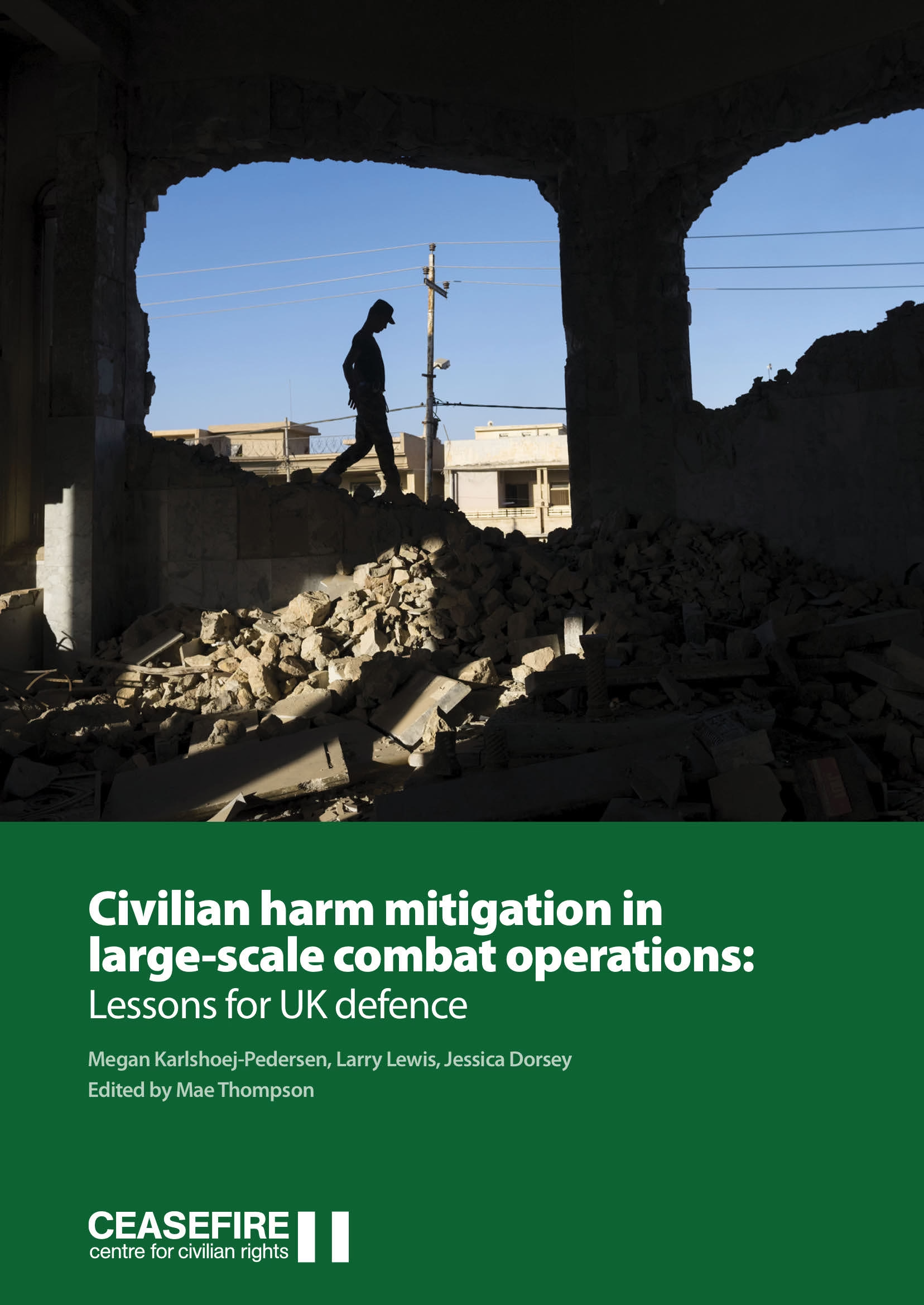
For our full recommendations, see: Civilian harm mitigation in large-scale combat operations: Lessons for UK defence and Civilian Protection Monitor Country report: United Kingdom 2024.
Key findings of the baseline study presented in the summary report:
- While the MoD finds that the prevention of civilian harm is deeply embedded in UK Defence Culture, there is not a singular CHMR policy. Rather, responsibilities relevant to CHMR are dispersed across multiple domains.
- UK Defence currently does not maintain a central register of civilian harm incidents or allegations.
- UK Defence does not have a formalised approach to civilian harm tracking. The absence of tracking systems undermines UK Defence’s ability to learn from incidents, demonstrate accountability, and engage credibly with external stakeholders.
- There are no formalised procedures for investigating civilian harm.
- Without a formal framework for collecting, analysing, and sharing information on civilian harm, Defence risks being reactive rather than proactive in its response to allegations or incidents.
- Formal response mechanisms have not evolved or been further developed since land campaigns in Iraq and Afghanistan. While legacy processes once existed for tracking civilian casualties, conducting investigations, and providing amends, these systems have fallen into disuse.
- Without explicit consideration of how CHMR should function in future warfighting scenarios, UK Defence risks applying inappropriate assumptions or facing unanticipated consequences.
Recommended action presented in the summary report:
- Establish a Community of Interest to explore the implications of introducing CHMR as a formalised capability,
- A costed assessment of professionalising CHMR,
- Clarification of policy ownership,
- Development of systems to track civilian harm and allegations.
- Formalisation of investigation procedures,
- Strengthen the use of open-source intelligence for post-strike analysis,
- Test assumptions about host-nation roles,
- Refresh legacy mechanisms for amends and post-harm response.
For media inquiries or further information, please contact: mae.thompson@ceasefire.org.