Today marks four years since Russia launched its full-scale invasion of Ukraine, escalating an armed aggression ongoing since 2014. On this grim anniversary, Ukrainian artist and activist Anna Moskalets shares how these four years have altered her life, her art, and her understanding of resistance.
My name is Anna Moskalets. I am a Ukrainian artist, independent curator and, almost against my own will, a social activist.
I say ‘against my own will’ because I never set out to be an activist. I became one because the alternative was to stay silent while everything around me was collapsing. When politics breaks into your home with missiles and occupation troops, ‘I’m not political’ stops being an option. You either engage, or politics will still rule your life – only then you have no say at all.
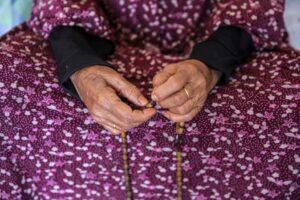
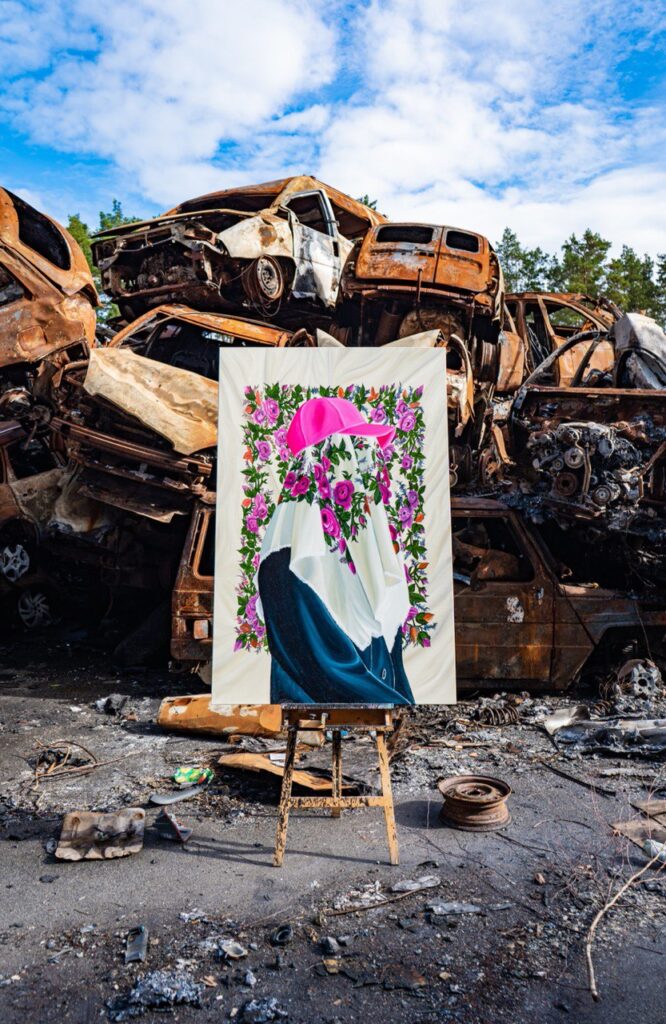
My artistic practice has always been deeply rooted in family history. I work with family archives and the stories of my ancestors, through the prism of women’s memory. Old photographs, letters, and especially my grandmother’s headscarves become the raw material of my work. This is not the first war my family has had to live through. Part of my family was killed during the Second World War; now, in this war, some of my relatives are fighting against the Russian army, and some have already been killed. When I work with these archives, I see how violence repeats itself across generations, and how women in particular carry and preserve memory – sometimes quietly, sometimes in ways that only become visible decades later.
I am now technically a refugee. My refugee journey began in February 2022, when Russia launched its full-scale invasion of Ukraine. On that day, I was in Kyiv, where I had been living for three years. Before that, I spent eleven years in Kharkiv. Originally, I am from Sumy region, very close to the Russian border. My parents, my grandmother (88 years old), my sister and my niece still live there.
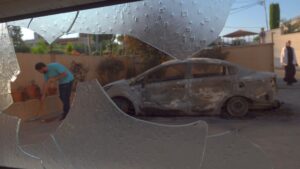
Sumy region is often described as ‘relatively safe’ now, but ‘relative’ is a cruel word. In the first weeks, it was occupied; later, it was de-occupied. The front moved, but the fear and uncertainty stayed. Lack of electricity, heating, water – things that should be unimaginable in the centre of Europe – have slowly become normalised for my family. That word, normalised, frightens me more than the explosions themselves.
Three months after the full-scale invasion, I left for Germany for what was supposed to be a temporary project. I received a scholarship from the Goethe-Institut and began working within the local cultural scene, always from a Ukrainian perspective. I took part in several projects, including a large Ukrainian-German collaboration in 2023 that was visited by the then Chancellor, Olaf Scholz. It was symbolically important: we were trying to make visible, through art, something that was beyond words – the experience of war, displacement, and resistance.
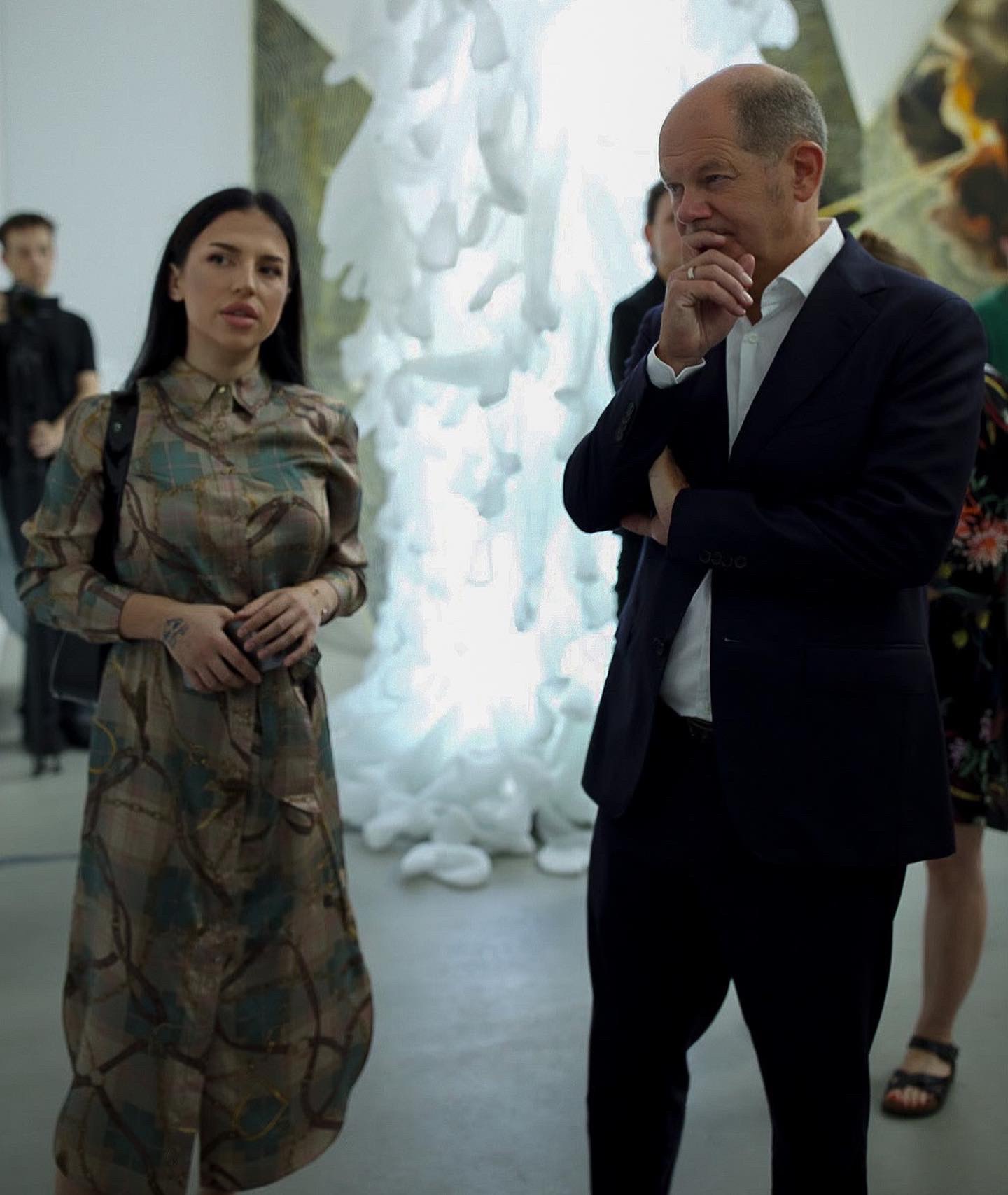
In Germany, I realised again how powerful art can be as a key that opens doors: to institutions, to politicians, to the media, to people’s emotions. But I also realised how limited it is if we pretend that art is ‘not political’. I often hear this phrase: ‘Art should stay out of politics’. My experience is the opposite. Everything is political, especially art. If we don’t consciously use it to question power and violence, then it easily becomes decoration for the very systems that oppress us. If you don’t participate in politics, politics will still use you – just without your consent.
Because of this, my artistic practice gradually morphed into open political engagement. I was invited to the Rathaus (local parliament) and Bundestag in Germany to talk about Ukraine, about Russia’s mass abduction of Ukrainian children, about victims of war. My role as ‘artist’ became inseparable from ‘witness’ and ‘advocate’.
In parallel, I began travelling to the United States, collaborating with different organisations and charities. One of the most meaningful collaborations was with the Sunflower Network, which has done a lot of work supporting Ukraine. Again, art became a bridge – a way to translate experiences of war to those who might otherwise only encounter them in headlines.
But headlines are never enough. I was, and still am, always waiting for the war to end. At some point, I had to confront the painful realisation that this waiting is not enough either. So, I decided to move to the UK, where I was fortunate to be able to develop new projects and to participate in political and human rights events. This is how I ended up at the British Parliament as a voice from Ukraine.
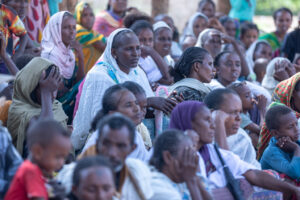
Britain has given me something important: distance. From here, I can see not only Ukraine’s war but also the many other wars and crises that rarely reach the front pages – Sudan, Afghanistan, and so many more. Sitting in parliamentary rooms and public discussions, I found myself deeply affected by stories from other countries. I recognised the same architecture of violence, the same pattern: people reduced to numbers, whole regions turned into ‘security issues’ rather than homes.
This experience pushed me to ask: what connects these struggles? What can we learn from one another? It feels morally impossible to ask the world to care about Ukraine while ignoring the suffering of others. Empathy is not a one-way street. If we want solidarity, we must also offer it. It is about exchange: sharing our experiences, listening to others, and building a common language of resistance and care.
At the same time, my own war is not abstract. It is very concrete, very personal. I am preparing to return to Ukraine this spring to work on new projects. I want to create these artworks in Ukraine itself – in Kharkiv, in my studio – not in some safe, distant place and then present them as ‘about Ukraine’. That would feel dishonest. Art born in the middle of sirens, power cuts and uncertainty is different from art made in comfort about those things. The risk is real: last November, while in Kharkiv, I found myself between three explosions near the house where I was staying. In those moments, you understand how fragile you are, how little control you have over anything.
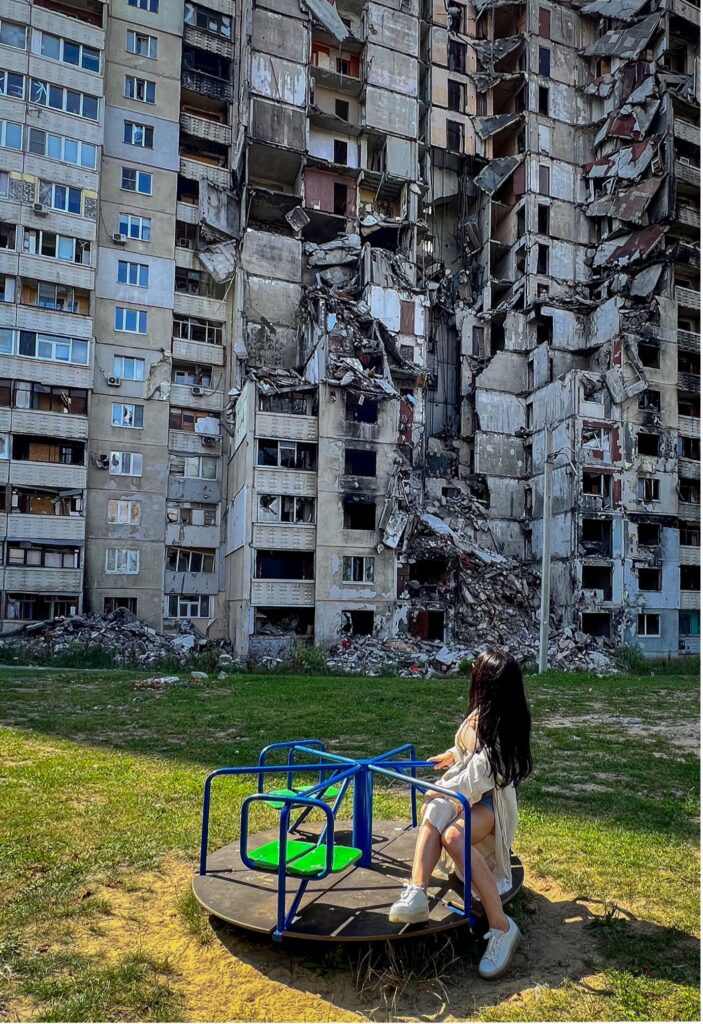
Surviving war carries its own strange kind of guilt. There is the guilt of survival – why am I alive and not the person who died today? There is the guilt of happiness – how can I feel joy, fall in love, laugh with friends, while others are under fire? There is the guilt of distance – speaking about war in safe rooms, flying to conferences, while your family sits in the dark during another blackout. This complex mix becomes a kind of permanent PTSD that, I suspect, will stay with me for the rest of my life. It is the price many of us are paying.
Someone once said, ‘Do what you can with what you have’. I return to this sentence often. I cannot stop missiles. I cannot protect my family from every danger. I cannot fix global geopolitics. But I can speak. I can create. I can connect people and stories. I can refuse to normalise this war – in Sumy, in Kharkiv, in Tigray, in Sudan, anywhere. I can insist that what is happening to us is not just ‘the new normal’, and that the same is true for others.
Despite everything, I remain profoundly Ukrainian. I respect and am grateful to Britain, Germany, the US, and all the countries that have supported us and welcomed people like me. But nothing is stronger than the feeling that you belong to a particular land, culture, language, and community. It is not nationalism; it is home. I want, more than anything, to go back and to live in a Ukraine that is not defined by war.
Until then, I will keep doing what I can with what I have: my voice, my art, my story. If there is one thing I hope readers take from this, it is that wars do not only happen ‘over there’ to ‘other people’. They happen to artists, grandmothers, sisters, children. To people who love, who argue, who cook dinner, who dream about their future.
I do not see myself as a victim, even though, objectively, I am one. I see myself as a witness and a participant in a struggle much bigger than me – a struggle for a world where no one’s suffering is invisible, and where solidarity crosses borders faster than missiles do.
And in spite of everything – the fear, the losses, the guilt – I am still happy to be alive, to be Ukrainian, and to have the chance to keep telling this story.
Photos courtesy of Anna Moskalets.